

Upright, console or studio piano
Show the piano from the front and side. Include its height and depth, where it stands now and the route to the exit. Access needs to accommodate the whole protected instrument, not just the width of its keyboard.
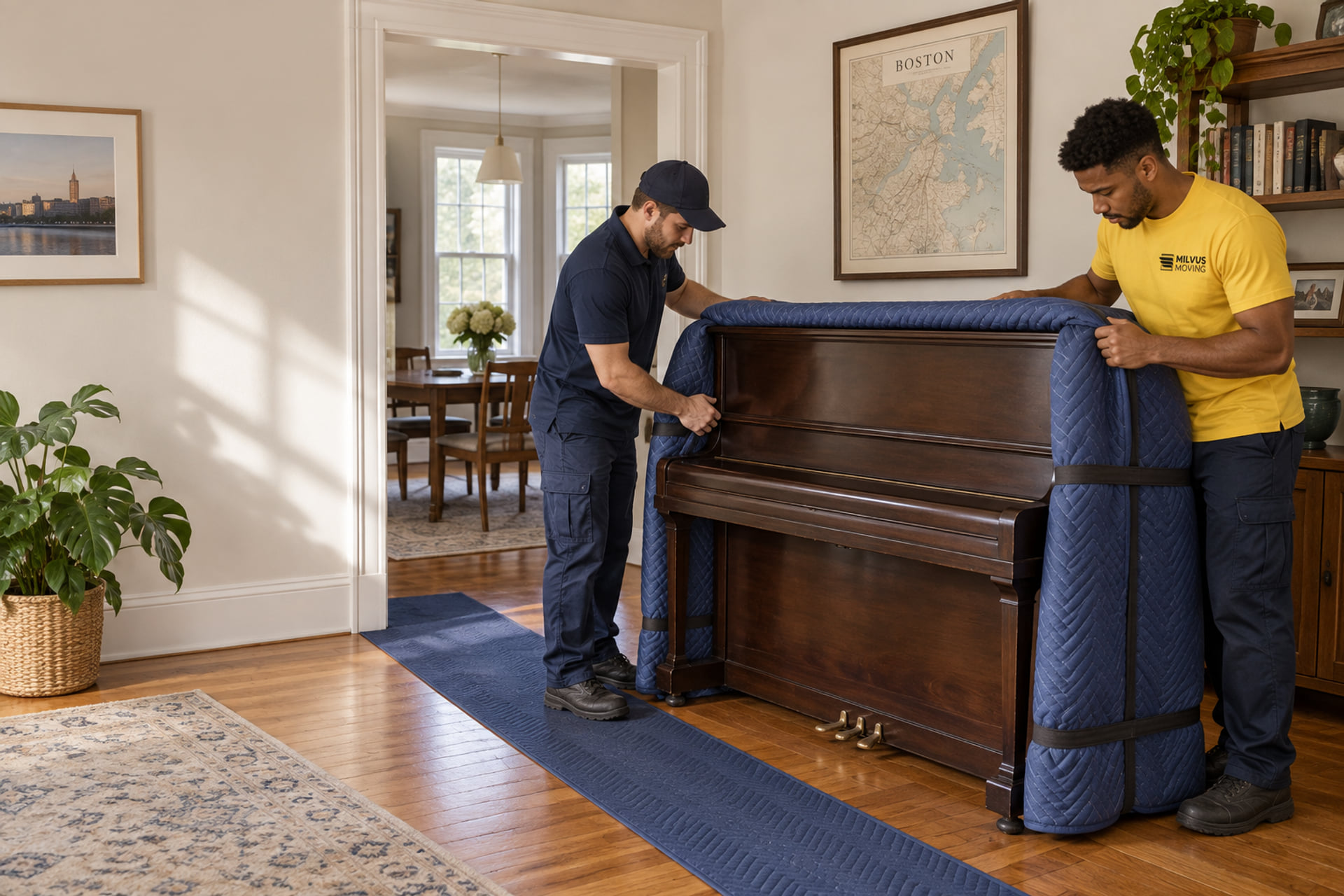
An upright in a second-floor apartment and a grand in a ground-floor music room need different moving plans. Milvus starts with the instrument and the access at both properties, then works through preparation, handling and placement. Include your piano early, whether it is moving alone or with your household.
Your estimate depends on the items, access and services you need.
Prefer to talk? 857-895-8955The piano’s appearance does not tell the whole story. Share its type, make and model if known, approximate dimensions and any condition issues that should be considered before handling. Photographs of the complete instrument are a useful starting point.
Show the piano from the front and side. Include its height and depth, where it stands now and the route to the exit. Access needs to accommodate the whole protected instrument, not just the width of its keyboard.
Provide the model and length, with photographs of the room and exit route. The handling team needs to assess the preparation, equipment and any disassembly appropriate to that instrument. Grand-piano work should not be treated as an ordinary furniture carry.
List the keyboard, stand, bench, pedals, speakers and accessories separately. Keep the manufacturer’s packing or assembly instructions if available. A cabinet-style digital piano has a different scope from a small keyboard in its original case.
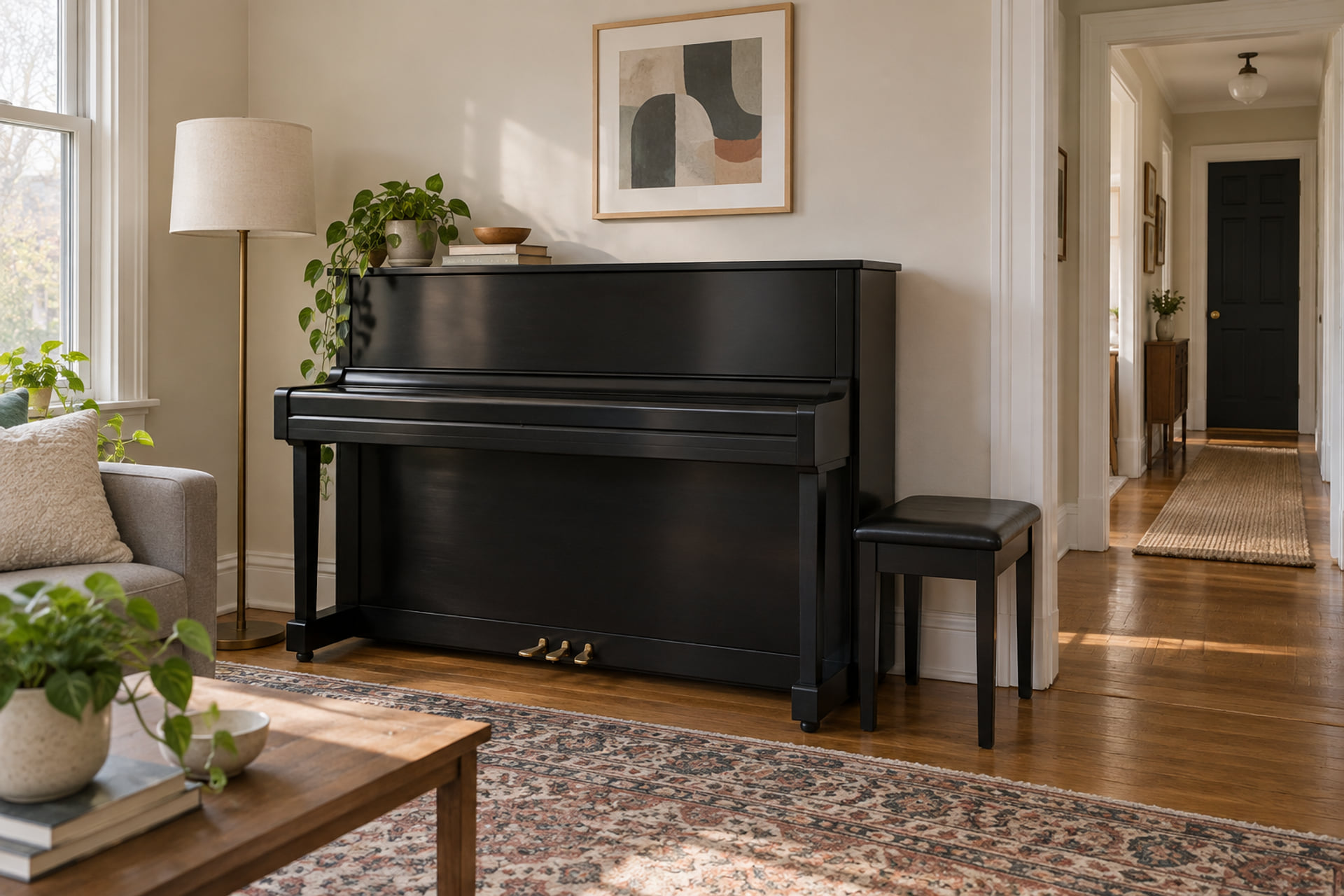
Describe the complete route from the piano’s current position to the truck. Note stairs, landings, narrow hallways, door openings, thresholds and outdoor steps. A few well-lit photographs often show an obstacle that would be difficult to explain by phone.
Repeat that exercise at the destination. Include the final room, floor and any elevator or loading arrangements. For a condo, performance space or rehearsal building, obtain management’s moving instructions, permitted times and any insurance documentation requirements before choosing the date.
Avoid planning around a piano’s own small casters. They do not establish that an instrument can be rolled across a room, over a threshold or into a vehicle without suitable assessment and equipment. Leave decisions about lifting and preparation to the handling team.
Send the make, model and type, photographs and dimensions. Mention a loose component, existing damage or a restoration concern before the handling plan is agreed.
Share addresses, floors, stairs, landings, elevator information and parking access. A change at the destination can alter the job even if the piano itself has not changed.
Review preparation, crew and equipment, transport, receiving arrangements and any requested storage. Make sure the estimate refers to the actual instrument and route.
Remove loose belongings from around the piano and clear the agreed route. Keep the bench and accessories identified, and have a person available to confirm placement at delivery.

A piano move needs attention to its cabinet, finish and vulnerable components, along with the floors, corners and door frames along the route. Tell the team about a recently restored finish or any special care instructions supplied by a technician.
Do not remove a grand piano’s legs, pedals or other components in anticipation of the move unless the agreed professional preparation specifically requires you to do so. The appropriate steps depend on the instrument and handling method. Loose parts should remain identified and associated with the correct piano.
Once the moving scope is confirmed, keep it stable. Moving another heavy item at the same appointment or changing the destination room may be possible, but it should be discussed while the crew and equipment are being planned.
There is no single piano price that describes every instrument and building. Ask for an estimate covering the complete job. A general household hourly rate should not be taken as a confirmed piano-moving rate.
| Detail | Why it matters |
|---|---|
| Instrument type and dimensions | An upright and a grand can require different preparation, handling equipment and crew arrangements. |
| Stairs and constrained access | Landings, turns, outdoor steps and narrow passages affect feasibility and how the work is organized. |
| Pickup and delivery locations | The route, travel, receiving access and any building appointment all belong in the estimate. |
| Preparation and additional items | Include the bench, accessories and other requested handling rather than adding them after the scope is agreed. |
| Storage or a gap between dates | Storage, handling into and out of it, and final delivery must be discussed separately when direct delivery is not possible. |
Choose the receiving room before delivery and check that the planned position works with the instrument, furniture and room access. A last-minute request to use a different floor or a much tighter corner can change the job.
Moving and tuning are different services. Ask your piano technician about the instrument’s placement, room conditions and when it should be assessed after the move. Milvus should not be assumed to provide tuning or repair as part of transportation.
If your new room will not be ready, raise the timing issue before pickup. Ask about the proposed storage arrangement, instrument requirements, handling charges, access and redelivery. Storage terms should be agreed for the piano rather than inferred from a general household storage price.
Have a different situation? Call 857-895-8955 and talk it through with Milvus.
Yes. Send the instrument details and access information for both properties so Milvus can assess the request. Availability, feasibility, handling arrangements and price are confirmed for the particular job.
Contact Milvus with the type, model and photographs of your upright or grand piano. We’ll review the instrument and access before confirming a handling plan and booking.
That depends on the instrument and the route. Provide photographs, dimensions, the number of flights and the shape of each landing. Do not assume all stairs are suitable or that a different route can be arranged on arrival.
Leave specialist preparation to the agreed professional handling plan. Do not remove structural components simply to make the instrument smaller. Tell the team about any components that are already loose or detached.
Do not assume tuning, repair or restoration is included in the moving service. Arrange those needs with a piano technician and ask for advice on assessment after transportation.
Mention this at the enquiry stage. Ask about the actual storage conditions, the instrument’s needs, access, charges and final delivery. Confirm an appropriate arrangement before the piano is collected.
Add the two addresses, floors and access details. We’ll review the instrument and the moving work together.